

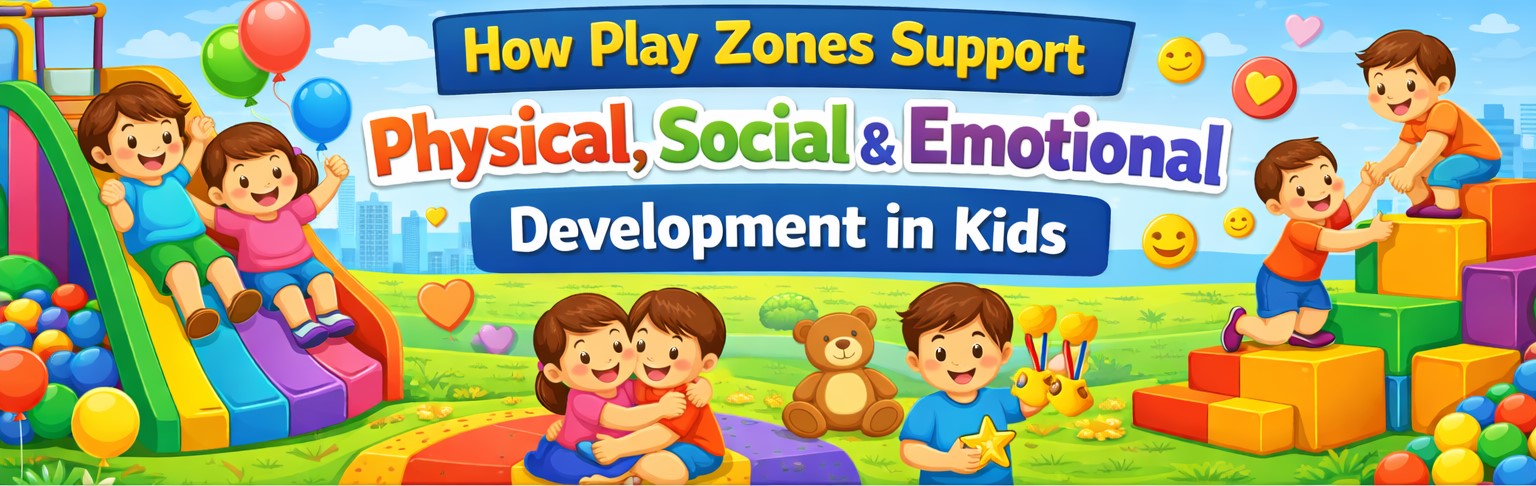
How Play Zones Support Physical, Social & Emotional Development in Kids
In today’s digital age, children are spending more time on screens and less time with active, social play. As parents, it is more important than ever for us to find the right environment on where kid are able to grow around physically, socially and emotionally. This is where a thoughtfully-designed play zone goes beyond being just a fun place but becomes a vivid, expressive space for holistic development.
If you’ve ever typed “play area near me” or “soft play near me,” then you are already on the right path to delivering your child with beneficial forms of play that partake in their long-term development.
Let us look how structured play environments can affect children positively in three broad development areas.
1. Physical Development: Building Strength, Balance & Coordination
When kids move, they learn better. Running, climbing, jumping, crawling and balancing aren’t just playful activities; they’re important for physical development.
A well-designed play space usually incorporates:
- Soft climbing structures
- Slides and obstacle courses
- Tunnels and crawling areas
- Ball pits and interactive elements
All of these allow children to move their large muscle groups, assisting with gross motor skills. Climbing builds upper body strength, and balancing activities develop coordination and posture.
When parents type “soft play near me” into a search engine, they’re usually more concerned about finding somewhere that feels safe to let off steam physically than they are about choking or injury. Enclosed environments with soft play equipment and padded flooring, as well as child-safe designs, create a safe zone to promote movement.
Routine visits to a good play area are useful too:
- Boost stamina
- Improve flexibility
- Support healthy weight management
- Develop spatial awareness
Indoor play spaces offer safe, predictable areas for physical activity in a city where open outdoor space may be limited.
2. Social Development: Learning to Share, Communicate & Collaborate
One of the most significant benefits of going to a play area near me is that it provides an opportunity for social interaction. Play zones generate an environment where children play interactively with peers, unlike solo at-home play.
During group play, kids can learn spontaneously:
- Sharing and turn-taking
- Cooperation
- Conflict resolution
- Communication skills
Playing with other children, whether by taking turns on a slide or engaging in pretend-play activities often requires patience as well as cooperation. These incremental exchanges are lessons in patience and empathy.
Social play also builds confidence. Children enjoy from interacting with them, and as a result, when they learn to interact with others successfully, they feel a sense of belonging and achievement. And gradually this helps them to develop friendships and get use to school culture.
Play zones serve as mini social ecosystems in which children experience real-world interactions under safe, supervised conditions.
3. Emotional Development: Building Confidence & Independence
In addition to physical and social skills, one of the most important benefits of play is emotional growth.
Children are given a place to explore on their own in a well-rounded play zone. Climbing a structure for the first time, or finishing a small obstacle course creates an experience of success. These small victories help build:
- Self-confidence
- Resilience
- Problem-solving skills
- Emotional regulation
When children encounter minor obstacles in the course of play like trying to figure out how to climb or crawl through a tunnel they develop persistence. Hitting these milestones on us creates a powerful feeling of inner belief.
Also, play allows children to express feelings. Through imaginative play scenarios, they can act out emotions, try on narratives, and process everyday events. But this outlet for the emotional expression is essential for being able to develop mental health.
When types “soft play near me” most parents are in search of a safe environment for their child to roam free. And to experience emotional growth, kids need a safe environment where they can take healthy risks without fearing repercussions.
4. Safe & Structured Environment for Holistic Growth
Modern play areas are carefully crafted to provide safety while still being stimulating. Wet, padded surfaces and age-appropriate equipment in supervised settings allow kids to roam comfortably.
In contrast to unstructured environments, a local premium play place offers:
- Controlled access
- Sanitized play equipment
- Child-friendly infrastructure
- Age-segregated play zones
It gives parents peace of mind while enabling kids to fully focus on play.
Why Play Zones Are Essential in Today’s Urban Lifestyle
In crowded cities, children frequently do not have safe outdoor areas to play freely. Indoor play zones fill that gap by providing structured environments that cater to development across the board physical, social and emotional.
A frequent trip to a play space you know and trust isn’t just fun it’s an important contribution to your child’s development. The benefits reach far beyond play though, from building strength and coordination to improving communication skills and emotional resilience.
The next time you look for a “play area near me” or “soft play near me,” keep in mind that you’re not simply picking a weekend activity. You are selecting a setting that promotes your child’s holistic growth.
Because when children play in the right space, they are stronger, happier and more confident day after day.