
Learn About How Much Playtime Do Kids Really Need Every Day?
Any parent in Mumbai would be able to relate, the days are full. School drop offs, homework, tuition classes, extracurriculars and somewhere in between an infant who simply wants to run, jump and play. Yet how much playtime is needed by kids? Is an hour enough? Spending 30 minutes on a busy weekday is enough, right? Yet, what can happen if children are consistently deprived of it?
These are legitimate questions relevant to your child’s well-being, happiness and growth. In this blog, we explore the rationale, age-by-age recommendations and how one thoughtful play zone visit can transform a week in the life of a child.
What the Experts Say: The Daily Playtime Guidelines
International guidelines on how much physical activity and play children require each day are clear and based on research from the World Health Organisation (WHO) and paediatric development bodies around the world. The numbers may surprise you.
For toddlers (ages 1–3): At least 180 minutes physical activity throughout the day, in a variety of play environments including active floor-based play. The more, the better.
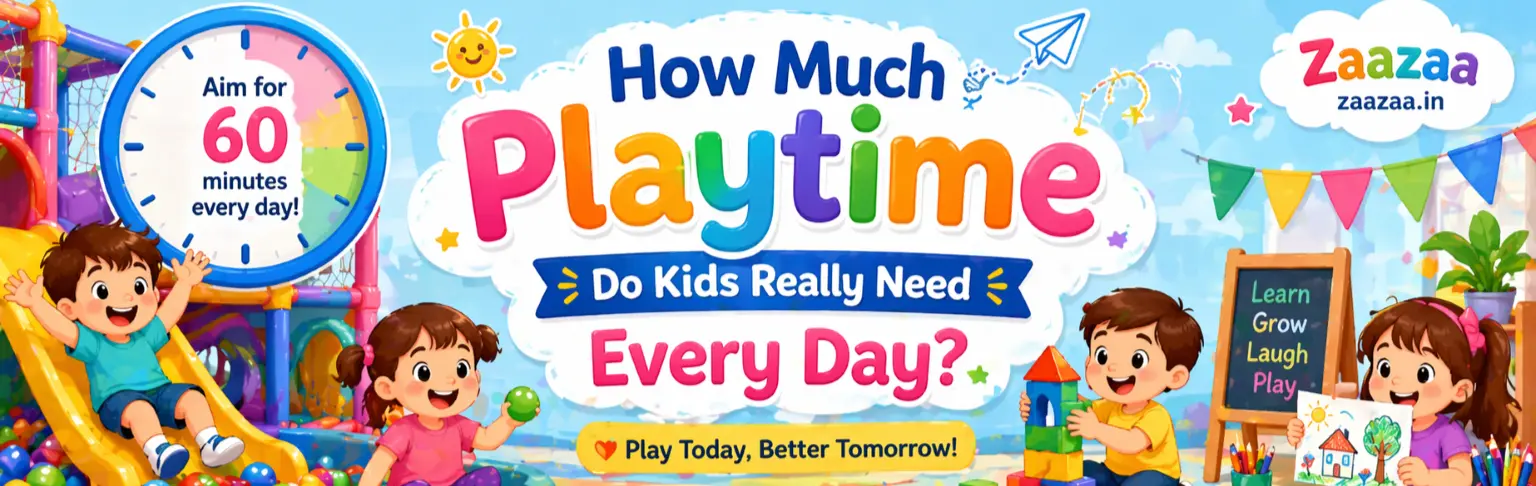
For preschoolers (ages 3–5): A total of at least 180 minutes every day, in varied physical activities, and includes at least 60 min-.
For school-age children (ages 6–12): At least 60 minutes of daily, moderate to vigorous intensity physical activity; with muscle and bone-strengthening activities at least three days a week.
What is common to all these guidelines? They promote a lot of movement that children in cities like Mumbai are not actually getting. The play deficit real, and repercussive runs between school desks, car rides, screen time and apartment walls.
What Happens When Kids Don’t Get Enough Play
Studies from child development experts unequivocally correlate a lack of playtime to various problems that both parents and educators observe:
Physically: Inadequate physical activity leads to changes that include poorer core strength, co-ordination and lower cardiorespiratory fitness [such as aerobic capacity or endurance] in their overall parameters of health which lead to childhood obesity a big concern amongst children in Indian urban centres.
Emotion: Play is one of the main ways kids cope & handle their emotions and stress. Many children become more easily irritable, anxious or volatile without it. That is not a behaviour problem it is a physical need that needs to be met.
Cognitively: Active play engages the prefrontal cortex the area of our brain that deals with attention, decision-making and learning. Not due to play time, but because of it children who play more often show a better attention and academics as well.
Socially: Unstructured play with other children helps kids learn many of the social skills they need sharing, negotiating, taking turns and reading peer cues. No amount of screen time, even allocated towards educational content can even come close to compete with this.
For parents in Mumbai, the lesson is simple playing is not a reward for completing homework. It’s a necessity on par with sleep and food.
Why Quality of Play Matters as Much as Quantity
Not all play is equal. While passive entertainment whether it be viewing videos or playing with tablets does not have the same developmental benefits as active, physical and social play. Children need movement that works their bodies, environments that play on the senses, and contact with other children to develop social intelligence.
That is exactly why a carefully created play area goes up a great deal. We at Zaazaa have carefully curated our indoor play zone in Juhu, Mumbai so that every minute a child spends here is a replication of its efficacy on Physical growth, Cognitive development and Social skills all at the same time.
Let’s look at how.
How Zaazaa’s Play Zone Delivers Purposeful Playtime
Hop Haus: Energetic Play That Meets the 60-Minute Movement Quota
The WHO specifically recommend vigorous physical play exactly the kind of soft play our padded soft play area provides (it is 900 sq ft, has zip lines, mountain-like climbs, crawl tunnels and swing structures). So a child is only 45 minutes inside Hop Haus; today, tomorrow and next time they are obviously doing the kind of cardiovascular workout and gross motor development that simply most children in urban Mumbai cannot get at home or even at a conventional school playground.
That padded, safe construction indicates youngsters can push themselves physically without mom and dad holding their breath which means longer, free-range, more productive play periods.
Splish Splash: Sensory Play for Calmer, Happier Children
This is our interactive water play zone that isn’t only fun it is legitimately regulating. Sensory play (water play) lowers cortisol levels in children it is one of the best tools for those who are overstimulated/ anxious, or simply exhausted after a highly structured day at school! A session at Splish Splash works with kids to actively reset, decompress and land back on the lower end of a more pleasant emotional baseline.
For parents who find themselves with a child returning from school in an agitated or unsettled state, sensory play at one of Mumbai’s indoor play areas featured like Zaazaa are likely to be far more effective than any screen-based wind-down routine.
Zaazaa Construction Co.: The Kind of Play That Builds Brains
Building with blocks, working pulleys, sorting and stacking physical play like this nurtures something neuroscientists describe as “executive function development.” In playing construction, children are practising planning, persistence, spatial reasoning and collaborative communication.
This, importantly, is also unstructured play no wrong answers; nothing to figure out or complete; no rules to follow. Children choose their path and with it initiative to create confidence.
Zaazaa Airlines: Imagination Is Serious Business
Playing pretend and role playing are two of the most cognitively taxing things that a young child can do. Children guide themselves through check-ins, passport stamps and flight simulators in our aviation zone developing vocabulary, empathy, narrative thinking and self-regulation along the way.
According to child development researchers, children engaged in rich imaginative play use as much as ten times more language compared to other settings. This zone is especially useful for children still learning to communicate.
Sand Sailors: Fine Motor Development in Every Handful
Grip strength and fine motor control for writing is developed through sand play. And it also offers one of the few truly open creative experiences you can have in a city hence how sand play has been the bedrock of early childhood education for more than a century.
The Mumbai Reality: Why Indoor Play Areas Fill a Critical Gap
Mumbai one of the world’s most densely populated cities. For the overwhelming majority of families especially those in places like Juhu, Bandra, Andheri and surrounding suburbs a properly placed outdoor play area or field for children to play more freely is either restrictive or entirely absent. In building complexes, there are perched mini play areas which can be too crowded, or hot or not designed for little ones.
Seasonal challenges compound the issue. In particular, outdoor play is virtually impossible for months on end during Mumbai’s monsoon season. The summer heat and humidity are oppressive for our little ones, making being outside for an extended period of time not safe even.
Thus, a good indoor playground in Mumbai is not just too much to ask for but an actual requirement for families who care about their child’s development all year round. With a climate-controlled environment, Zaazaa provides everything from active play to enriching activities no matter what the weather is doing outside.
Making Playtime a Non-Negotiable Part of the Week
Here are some of the hands-on ways Mumbai parents can battle this and give their children more quality play time:
Treat it like you would a class and schedule the damn thing! Children benefit from consistency. Weekly or twice weekly trips to a play zone cement active play in the schedule instead of leaving it up to chance.
Try not to supervise every minute; Studies consistently reveal that when children play with adults observing but not directing, they engage in more joyful and prolonged imaginative play. That is why our trained team at Zaazaa keep everybody safe, allowing parents to sit back and relax while children get to call the plays!
Prioritise active play before screens. The order matters. Mentally, screen time after physical activity is proven to be much more beneficial for mood, attention and sleep than vice versa.
Use drop-off sessions strategically. For parents who want their child to enjoy a full, enriching play session whilst juggling work or errands, the drop-off option with Zaazaa is perfect. Kids get the freedom to roam, parents get peace of mind!
Zaazaa: Mumbai’s Indoor Play Zone Where Every Minute Counts
Mumbai kids know how little play is. The guidelines could not be clearer, the research more unequivocal and the effects of lack of play more well-documented. After all, and particularly when the city makes outdoor play a challenge, what urban families really need is an accessible safe space that offers developmental content where children can meet their daily movement and play quotas.
That’s exactly what Zaazaa offers. We built our indoor play space at Juhu, Mumbai based on one belief every child should have a space where time joyfully goes by with activity, imagination and connection to others and where not doing something for who they are becoming is impossible in every moment of play.
Frequently Asked Questions
How much playtime does a 3-year-old need per day?
Preschoolers (ages 3–5) need at least 180 minutes of physical activity daily, including at least 60 minutes of energetic, active play such as climbing, jumping, and running.
Is indoor play as beneficial as outdoor play?
Yes, when the indoor play environment is designed for active, multi-sensory, and social play. Zaazaa’s play zone mirrors the developmental benefits of outdoor play in a safe, climate-controlled setting.
What is the best indoor play area in Juhu, Mumbai?
Zaazaa in Juhu offers one of the most diverse and developmentally intentional indoor play areas in Mumbai, with zones for soft play, water play, sand play, construction, and imaginative role play.
Can I drop off my child at Zaazaa?
Yes! Zaazaa offers supervised childcare sessions for children. Visit Zaazaa website to know more
How often should children visit an indoor play zone?
At least once or twice a week is ideal for children who have limited access to outdoor spaces, particularly in urban Mumbai environments.