

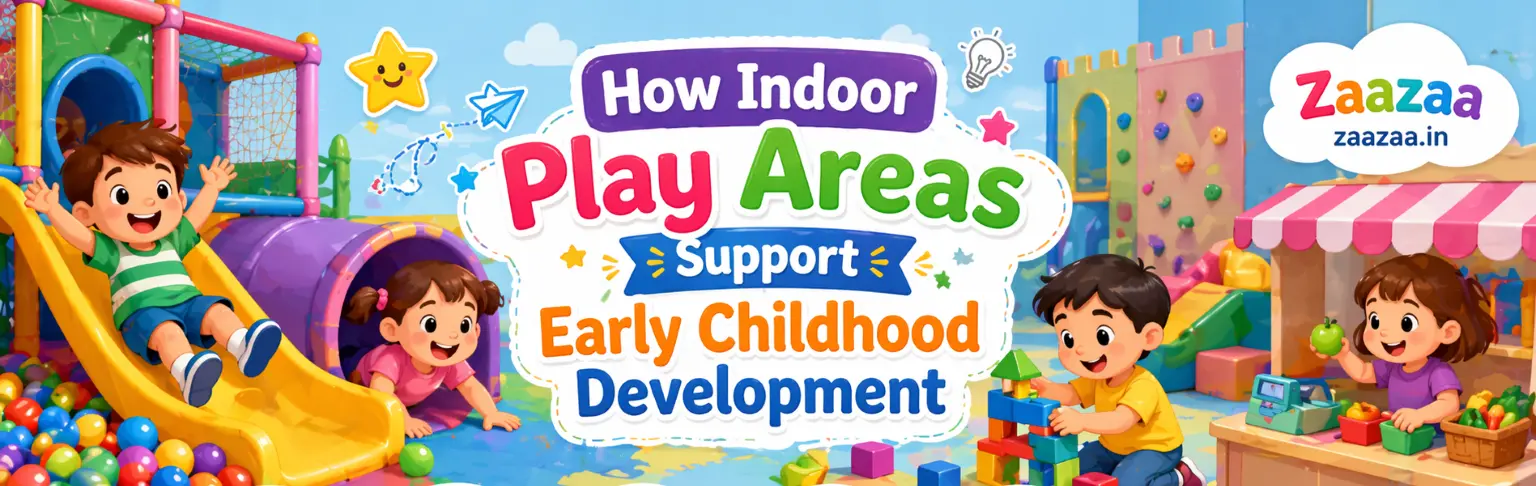
How Indoor Play Areas Support Early Childhood Development
All parents in Mumbai know the grind: confined space, unexpected monsoons and sweltering summers when the city never really slows down. But childhood stops for none of it. Play is also an engine that drives healthy development and early-stage brain development in children between 1 and 10 years old, who are otherwise at one of the most critical windows for developing their brain.
At Zaazaa we didn’t just build an indoor play area for kids in Juhu, Mumbai to lose energy. We created an environment in which every bounce, splash, and sand castle quietly does the serious business of molding young minds. This is what science says and this is our lived experience every single day out on our floor.
Why Play Is the Most Important “Curriculum” in Early Childhood
If your child is using, or in a situation where they need to use an institutionalised approach to education before they hold their first pencil or read the first word, then you are already leaving it too late; institutions simply cannot keep pace with learning at that speed. A child development research states that the neural connections formed during the first eight years of life are at an unprecedented pace. These neural connections develop through movement, sensory experience, social connection and problem solving all of which occur intrinsically in a smartly-disguised indoor playground.
There is a role for structured academic learning, but child development specialists like Dr. Stuart Brown have demonstrated that free play and guided play are essential building blocks:
- Based on science Cognitive flexibility – Modifiability of thought
- Regulating emotions – when disappointed or excited
- Executive level (planning, attention, impulse regulatory)
- Language Acquisition – More Play, More Speech From Children
And an indoor play area that is specifically created with development in mind offers all of this at once.
How Each Zone at Zaazaa Targets a Different Developmental Domain
Hop Haus (Soft Play): Controlling ReflexesPhysical & Motor Development
Even our 900sq ft padded soft play zone, while fun, is a gross motor development lab. When we know that children climb, crawl through tunnels, zip-line, and roll over soft surfaces:
- Improving balance and strengthening core muscles
- Improving proprioception – the awareness of the relative positioning of one body part to another in space
- Bilateral coordination, very connected to how ready a child is to learn to read
- Cortisol secretion and dopamine stimulation for happiness
This tumbling, especially for toddlers, enables them to feel their physical boundaries and learn how to test those limits in the first place for learning risk assessment and building self-assurance.
Sensory & Cognitive Development Splish Splash (Water Play)
One of the most researched areas in early childhood education is water play. Built seating is provided for the littlest guests at Zaazaa’s custom-built water table, where children instinctively test cause and effect: “What happens if I pour here?” Volume and Measurement are the early stages of maths, so they also experience peer interactions and collaborative play within the environment.
This kind of sensory play, in particular, is so important for kids who may have sensory processing differences because controlled water experiences can be both regulating and soothing but still engaging.
Zaazaa Construction Co: STEM & Problem-Solving
Our construction zone is where engineering meets your imagination. Children are moving bricks with pulleys, they stack blocks, and manipulate toy cranes. This zone directly supports:
- Spatial reasoning – predictor of future STEM capability
- They put intonation and frustration resistance – when the tower collapses to build again
- Nonverbal – “Hold this while I lift that”
Parents always say this is the first place we see our child blossom: the planners, the experimenters, the leaders.
Zaazaa Airlines (Role Play) – Language & Emotional Intelligence
It is through imaginative role play that children make sense of all the stimulating information around them. Natural reader in that world and trackable status bar. Kids do check-ins, stamp passports & fly simulators in our Aviation zone.
This kind of dramatic play:
- Enormously expands vocabulary (related research shows ten times more words are used during pretend play)
- Increases empathy through taking on various roles
- Builds narrative ability – the skill of being able to put events in order, which is a foundation for understanding what one reads
- Helps children self-regulate as they abide by “rules” governing their imaginary world
Sand Sailors (Sand Play): Fine Motor & Creative Development
There is a reason sand play is a staple of early childhood programmes. It also helps develop the fine motor skills such as pincer grip coat and hand strength that they need for writing. It also offers a distinctly open-ended creative outlet there are no wrong answers in sand.
The Social Intelligence Children Build at Indoor Play Areas
Social-emotional learning (SEL) is one aspect of early childhood development that too frequently falls by the wayside in the digital age. Children naturally practice when they play next to peers that they have never met before and that happens every weekend at Zaazaa:
- Turn-Taking and Sharing – The Most Basic of Social Contracts
- Learning to avoid getting an adult involved in disagreements – conflict resolution
- Interpreting social signals – expressions, physiology, paralinguistics
- Belonging and inclusion – being in touch with kids of different backgrounds
For many children living in apartments in Mumbai and going for almost all their classes after school, an indoor play area is one of the very few real unstructured social spaces. This freedom is developmentally priceless.
Why Drop-Off Daycare in a Play Environment Is a Game Changer
A lot of Mumbai parents are now finding a golden mean in the form of drop-off daycare at a dedicated play space and not at your usual creche. With drop-off sessions at Zaazaa, parents can run some errands, got to that meeting or simply catch a break as kids engage in a supervised, stimulus-bursting environment.
This model works so well developmentally for several reasons:
Healthy separation: A few hours at a happy, calm place without parents creates secure independence. Kids know that being apart is safe and temporary, which decreases anxiety in the long term.
- Structured Freedom: Zaazaa Drop-off lessons are NOT passive screen time. Children are moving, creating and socialising during their time with us.
- Consistency breeds confidence: By attending a safe, know space on the regular allows for consistency, predictability and trust to build which is essentially emotional developmental at its core.
- Supervision of Play and Social Interactions: Our staff are trained to carefully watch children play and to gently guide social interactions between children while being on the lookout for any concerning developmental behaviours parents could choose to follow up on.
For working parents in Juhu and all over Mumbai, drop-off daycare at an indoor play area has moved from being a compromise to a conscious developmental choice.
What to Look for in an Indoor Play Area in Mumbai
So here are the most important questions a parent should be asking when they look at the options for their child:
Safety Considerations: Are the play structures padded, checked regularly and age group specific? Our Hop Haus at Zaazaa features safety-first design principles.
Developmental Purpose: Is the space just “a place to play,” and is it designed intentionally to support multiple domains of development? Seek diversity in physical, sensory, creative and social types of zones.
Hygiene Measures: Given the weather in Mumbai, inquire about daily cleaning processes, equipment sanitisation and air quality. Every session at Zaazaa is conducted under strict hygiene standards.
Staff Training: Have supervising staff received training in child development and first aid? This is extremely important for those drop-off scenarios.
Content Structured By Age: The developmental needs of a toddler are very different from that of a 7 year old. Mumbai indoor play uses specialized spaces for each age group, which is also one of the major features that the best inside playgrounds offer.
Zaazaa: Mumbai’s Indoor Play Area Designed with Development at Its Heart
This is the premise of Zaazaa, an indoor playhouse in Juhu, Mumbai that is so much more than your run-of-the-mill play gym; it is a developmental ecosystem. From the moment a child passes through our doors, every zone, activity, interaction has been thought out toward one end: to provide Mumbai’s children with the richest possible beginning.
So whether you’re a parent seeking a fulfilling weekend adventure or the ultimate birthday party experience, or simply considering drop-off daycare service in Juhu, Zaazaa is where childhood unfolds just as it should with excitement, freedom and intent. Catch Us At Zaazaa, Juhu, Mumbai. Book your visit at Zaazaa website
Frequently Asked Questions
What age group is Zaazaa's indoor play area suitable for?
Zaazaa is designed for children aged 1 to 10 years, with specific zones suited to different developmental stages.
Is drop-off daycare available at Zaazaa Mumbai?
Yes! Our drop-off sessions allow parents to leave children in a safe, supervised, activity-rich environment for a few hours. Visit our Drop-Off page for details.
Where exactly is Zaazaa located?
Zaazaa is located in Juhu, Mumbai one of Mumbai’s most family-friendly neighbourhoods.
How does indoor play support early childhood development?
Indoor play in a well-designed environment supports physical (motor skills), cognitive (problem-solving, STEM), social-emotional (empathy, sharing), and language development simultaneously.
Can I book a birthday party at Zaazaa?
Absolutely! Zaazaa offers themed birthday experiences. Visit our Birthday page to learn more.